
Do Protests Make Difference? The role of protests in activist campaigns
026. Making Protest Count: How to Maximise the Impact of Public Demonstrations + Historical Examples of Successful and Unsuccessful Protests

Q: Do protests actually make a difference? I went to my first protest about 6 months ago and while the energy of being around like-minded individuals was something really special, I’ve been questioning whether or not the protest actually contributed to any actual changes.
Protests are one of the most visible and dynamic forms of activism, often capturing public attention and becoming symbols of resistance. However, their effectiveness in driving real change is frequently debated. While history provides numerous examples of successful protests leading to transformative change, there are also instances where demonstrations failed to achieve their goals. To understand their role in social change, it is crucial to examine the different functions of protests, the conditions under which they succeed, and the pitfalls that can hinder their impact.
Protests should be undertaken as part of a wider campaign strategy. An effective activist campaign strategy consists of a final goal, a clear and overarching change the campaign seeks to achieve, which serves as the guiding vision for all actions. To reach this goal, the strategy is broken down into objectives, which are specific, measurable steps that must be accomplished along the way. Each objective represents a milestone that brings the campaign closer to success. To achieve these objectives, activists employ tactics, which are the concrete actions and methods used to exert pressure, build support, and create change. Tactics can include protests, lobbying, public awareness campaigns, petitions, and direct engagement with decision-makers. A well-structured campaign ensures that all tactics align with the objectives, and each objective contributes meaningfully to the final goal, creating a strategic pathway from problem identification to transformative change.
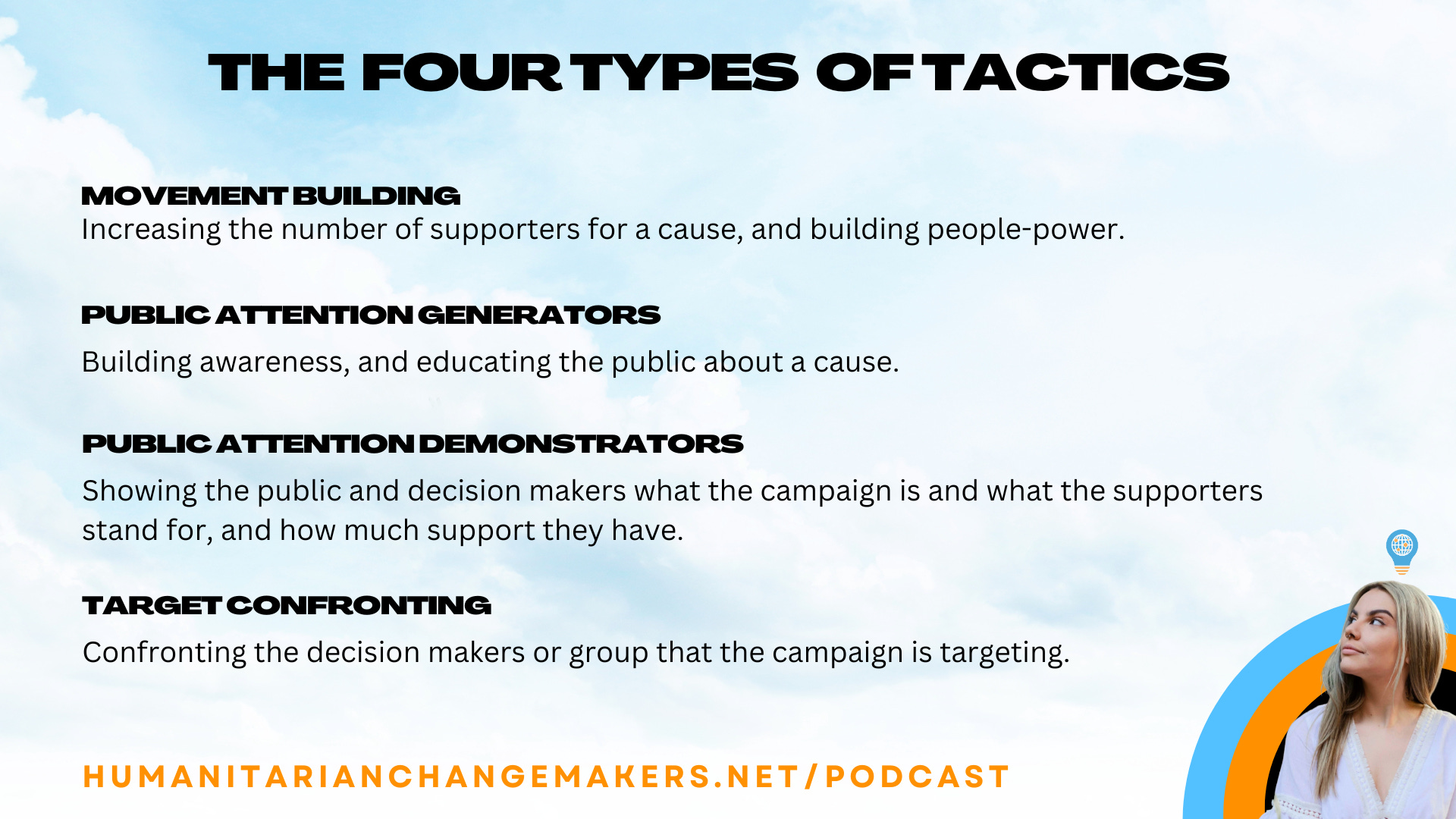
The Functions of Protests as a Tactic
Protests are not just singular events but strategic tactics within broader movements. Their effectiveness depends on their purpose and how they fit into the larger campaign for change. Generally, protests serve four key functions:
1. Building a Movement: Protests help expand the base of supporters for a cause, mobilising individuals and fostering a sense of solidarity. When people witness others taking action, they are more likely to join the movement, increasing its legitimacy and influence.
2. Generating Public Attention: By drawing media coverage and public discourse, protests serve as educational tools, informing society about issues that may otherwise be ignored. Visibility is essential for shaping public opinion and creating the conditions necessary for policy or social change.
3. Demonstrating Public Support: A well-attended protest showcases the level of public commitment to a cause. Large demonstrations can send a powerful message to decision-makers that a significant portion of the population demands action, pressuring them to respond.
4. Confronting Decision-Makers: Direct action protests, such as sit-ins, strikes, or demonstrations outside government buildings, apply direct pressure on those in power. By disrupting the status quo, protests can force engagement and prompt negotiations.
Integrating Protests into a Broader Strategy
Protests alone are rarely enough to achieve systemic change. Instead, they must be part of a larger strategy that includes other tactics such as:
Petitions and Advocacy: Demonstrating public support through petitions, letters, and direct lobbying efforts can reinforce the message of a protest.
Media Campaigns: Protests generate visuals and narratives that can be leveraged in traditional and social media to shape public discourse.
Community Organising: Protests help build networks of committed supporters who can continue to take action beyond a single event.
Legal and Political Engagement: Many successful protests work in tandem with legal challenges, policy proposals, or electoral strategies to push for institutional change.
Historical Examples of Successful and Unsuccessful Protests
Throughout history, protests have played a crucial role in shaping societies, influencing policies, and challenging injustices. However, their success depends on various factors, including timing, strategy, public support, and government response.
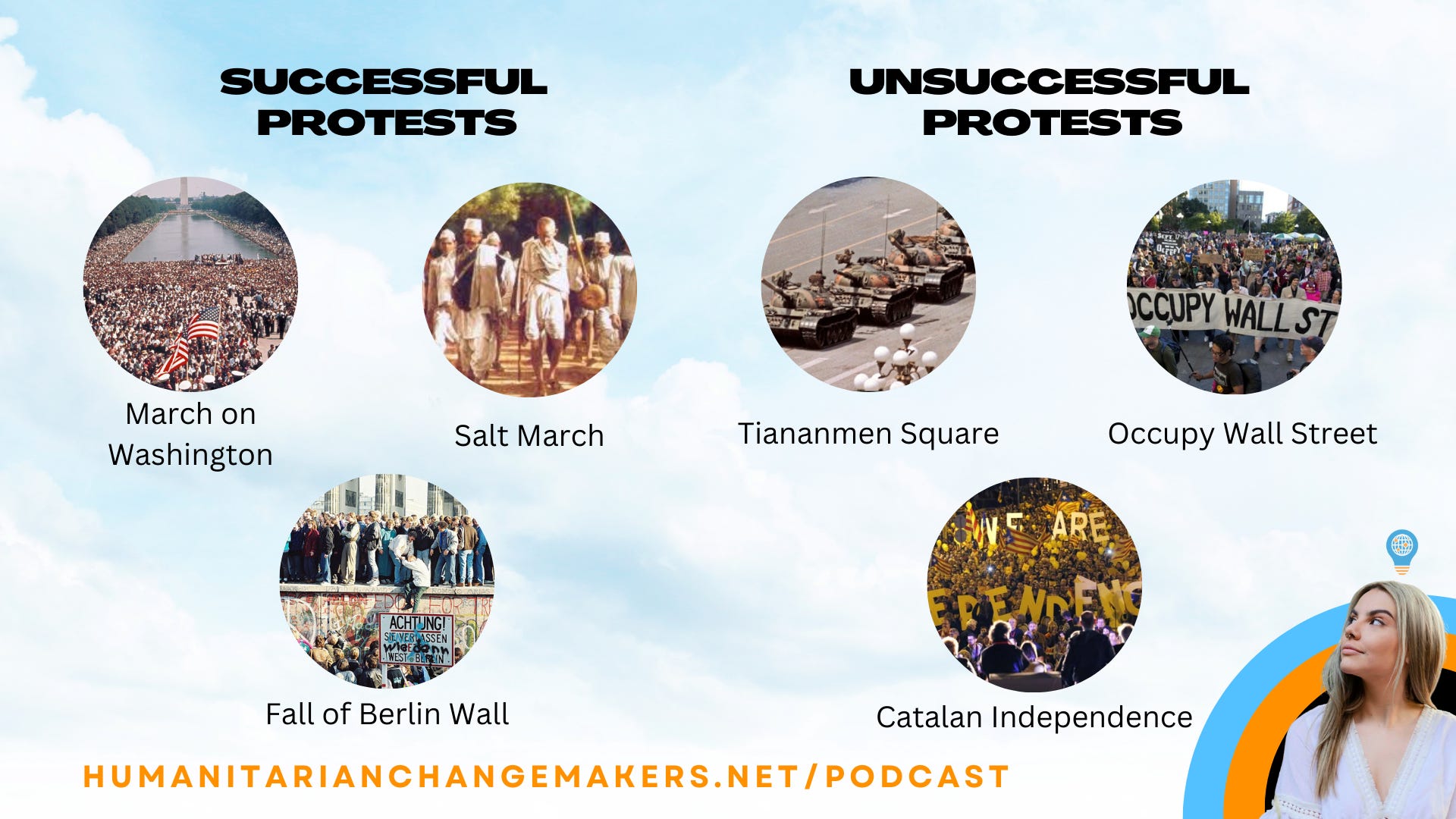
Successful Protests
1. The Civil Rights Movement (United States, 1950s–1960s)
The Civil Rights Movement in the U.S. is one of the most significant examples of successful protests. The Montgomery Bus Boycott (1955–1956), sparked by Rosa Parks' arrest, demonstrated the economic power of Black communities and led to the desegregation of buses. Similarly, the March on Washington (1963), where Martin Luther King Jr. delivered his "I Have a Dream" speech, helped galvanise public support and political pressure, contributing to the passage of the Civil Rights Act (1964) and the Voting Rights Act (1965). The movement's success was due to its strategic planning, sustained activism, and ability to mobilise broad coalitions.
2. The Indian Independence Movement (1919–1947)
Led by Mahatma Gandhi, the Indian independence movement employed nonviolent resistance and civil disobedience to challenge British colonial rule. The Salt March (1930), a 240-mile protest against the British salt monopoly, symbolised defiance and mobilised thousands of Indians in acts of nonviolent resistance. The movement's persistence and ability to gain international attention eventually led to India gaining independence in 1947.
3. The Fall of the Berlin Wall (Germany, 1989)
Peaceful protests in East Germany, including mass demonstrations in Leipzig and Berlin, pressured the government to open borders. The Monday Demonstrations grew in size, with chants of “We are the people!” and “We want out!” capturing the public's desire for freedom. When East German officials mismanaged a press conference on November 9, 1989, thousands of people flocked to the Berlin Wall, leading to its fall. The protests were effective because they occurred at a time of political instability in the Soviet bloc and had widespread public support.
4. The Arab Spring (Tunisia, 2010–2011)
The Tunisian Revolution was the catalyst for the Arab Spring, a wave of protests across the Middle East and North Africa. Triggered by the self-immolation of Mohamed Bouazizi in December 2010, protests against corruption, unemployment, and authoritarian rule quickly spread. The demonstrations led to the overthrow of President Zine El Abidine Ben Ali in January 2011 and inspired uprisings in other countries. Tunisia’s transition to democracy, while challenging, was one of the few lasting successes of the Arab Spring.
5. The Women’s Suffrage Movement (Late 19th–Early 20th Century)
The fight for women’s voting rights involved decades of protest, civil disobedience, and advocacy. In the United Kingdom, suffragettes engaged in hunger strikes and public demonstrations, leading to the Representation of the People Act (1918), which granted voting rights to some women. In the United States, the women’s suffrage movement, exemplified by the 1913 Women’s March on Washington and the Silent Sentinels protests, culminated in the passage of the 19th Amendment (1920).
Unsuccessful Protests
1. The Tiananmen Square Protests (China, 1989)
The pro-democracy protests in Beijing’s Tiananmen Square were led by students demanding political reforms, freedom of speech, and an end to government corruption. The movement gained momentum, drawing tens of thousands of protesters. However, on June 4, 1989, the Chinese government violently suppressed the demonstrations, using military force to clear the square. Thousands were killed or imprisoned, and the Chinese Communist Party tightened political control. The lack of political will for reform and the government’s authoritarian grip led to the movement’s failure.
2. Occupy Wall Street (United States, 2011)
Occupy Wall Street (OWS) began as a protest against economic inequality and corporate influence in politics. The movement’s slogan, “We are the 99%,” resonated with many, sparking similar protests globally. However, OWS struggled with a lack of clear leadership, concrete demands, and a unified strategy. Without a clear pathway for political or legislative change, the movement lost momentum and ultimately faded, despite raising public awareness about wealth disparity.
3. The Arab Spring (Egypt, 2011–2013)
While the Arab Spring led to the ousting of Egyptian President Hosni Mubarak in 2011, the movement’s gains were short-lived. In 2013, the military overthrew the democratically elected government of Mohamed Morsi, leading to a period of renewed authoritarianism under Abdel Fattah el-Sisi. The lack of cohesive leadership, the military’s strong influence, and internal divisions among activists contributed to the revolution’s reversal.
4. The 2017 Catalan Independence Referendum (Spain)
The 2017 Catalan independence referendum sought to establish Catalonia as an independent state. Despite mass protests and a contested vote in favour of independence, the Spanish government declared the referendum illegal, suspended Catalonia’s autonomy, and arrested key leaders. The lack of international recognition and the Spanish state’s forceful response prevented the movement from achieving its goal.
5. The 2020 Belarus Protests
Following the widely disputed re-election of President Alexander Lukashenko, mass protests erupted in Belarus, demanding democracy and an end to authoritarian rule. While the movement demonstrated widespread public opposition, the government responded with violent crackdowns, mass arrests, and media suppression. Without significant international intervention or internal fractures in the ruling elite, the protests ultimately failed to bring about political change.
Factors Contributing to Successful Protests:
Clear Objectives: Successful movements have well-defined goals, such as ending segregation (Civil Rights Movement) or gaining independence (India).
Strategic Planning: Effective campaigns align protests with other tactics, such as legal challenges, advocacy, and media engagement.
Broad Public Support: Movements that mobilise widespread participation, beyond activists, exert greater pressure on decision-makers.
Timing and Political Opportunity: Protests that capitalise on political crises or weak governments (e.g., Fall of the Berlin Wall) have a higher chance of success.
Common Causes of Failure:
Lack of Clear Leadership: Movements without central leadership or coordination struggle to maintain momentum (e.g., Occupy Wall Street).
Government Repression: In authoritarian states, violent crackdowns can suppress protests (e.g., Tiananmen Square).
No Clear Demands: Without specific, achievable objectives, protests risk losing direction and effectiveness.
Failure to Sustain Momentum: Short-lived protests that do not evolve into broader strategies often fade without achieving change.
Protests can be powerful tools for social and political change, but they are not inherently successful. Their impact depends on strategic organisation, public engagement, and the broader political environment. Historical examples show that protests are most effective when they are part of a larger movement, clearly articulate their demands, and sustain pressure over time. While some protests lead to lasting transformations, others serve as cautionary tales of movements that lacked strategic direction or faced overwhelming opposition. Understanding these dynamics can help activists design more effective campaigns for change.